We Built an AI Visibility Tool. Then We Tested Ourselves. The Result Was Zero.
Why an AI visibility score is only the beginning, and why the answer transcript matters more.
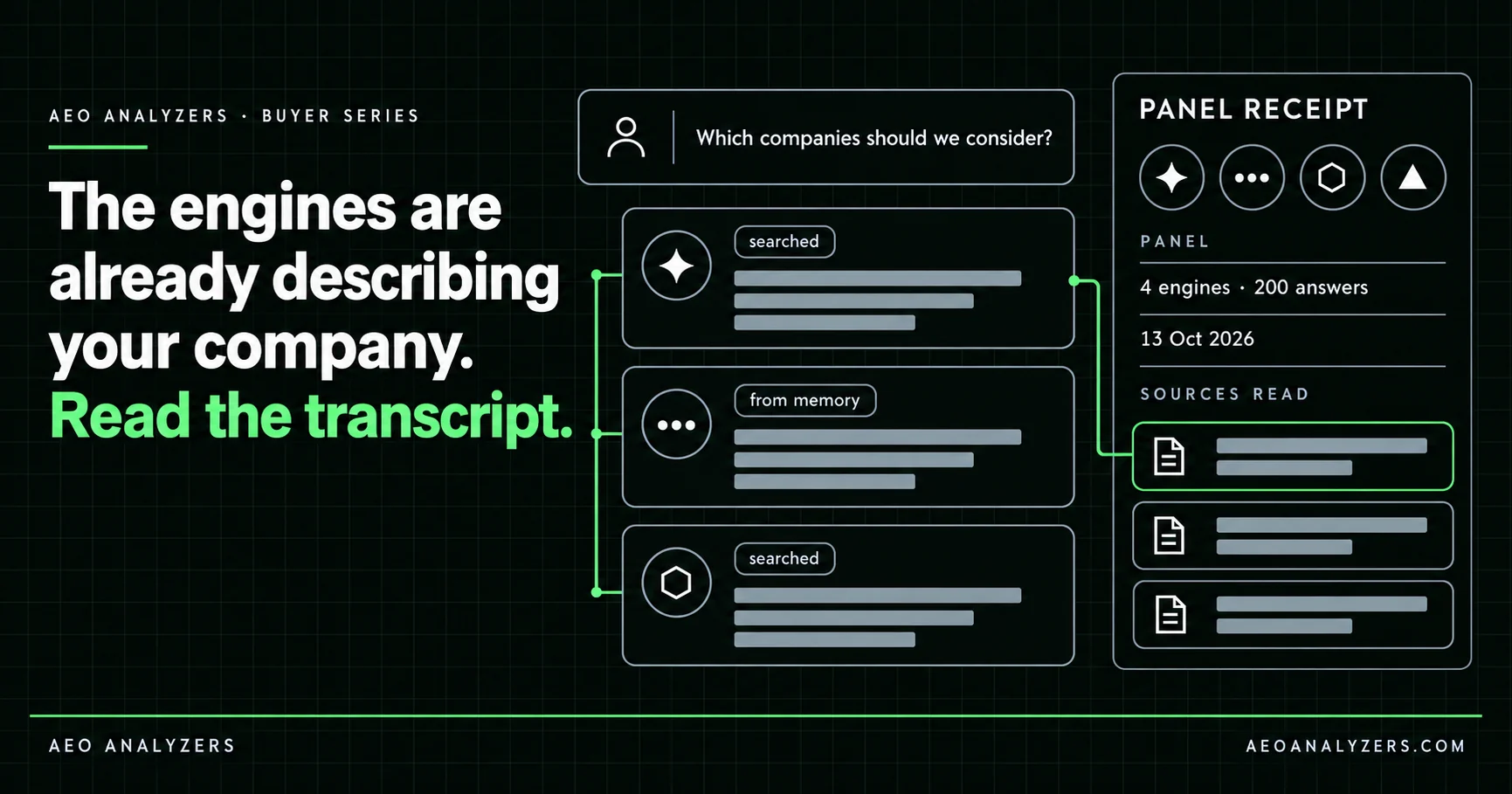
We built a tool to measure whether AI engines recommend businesses. Then we pointed it at our own company.
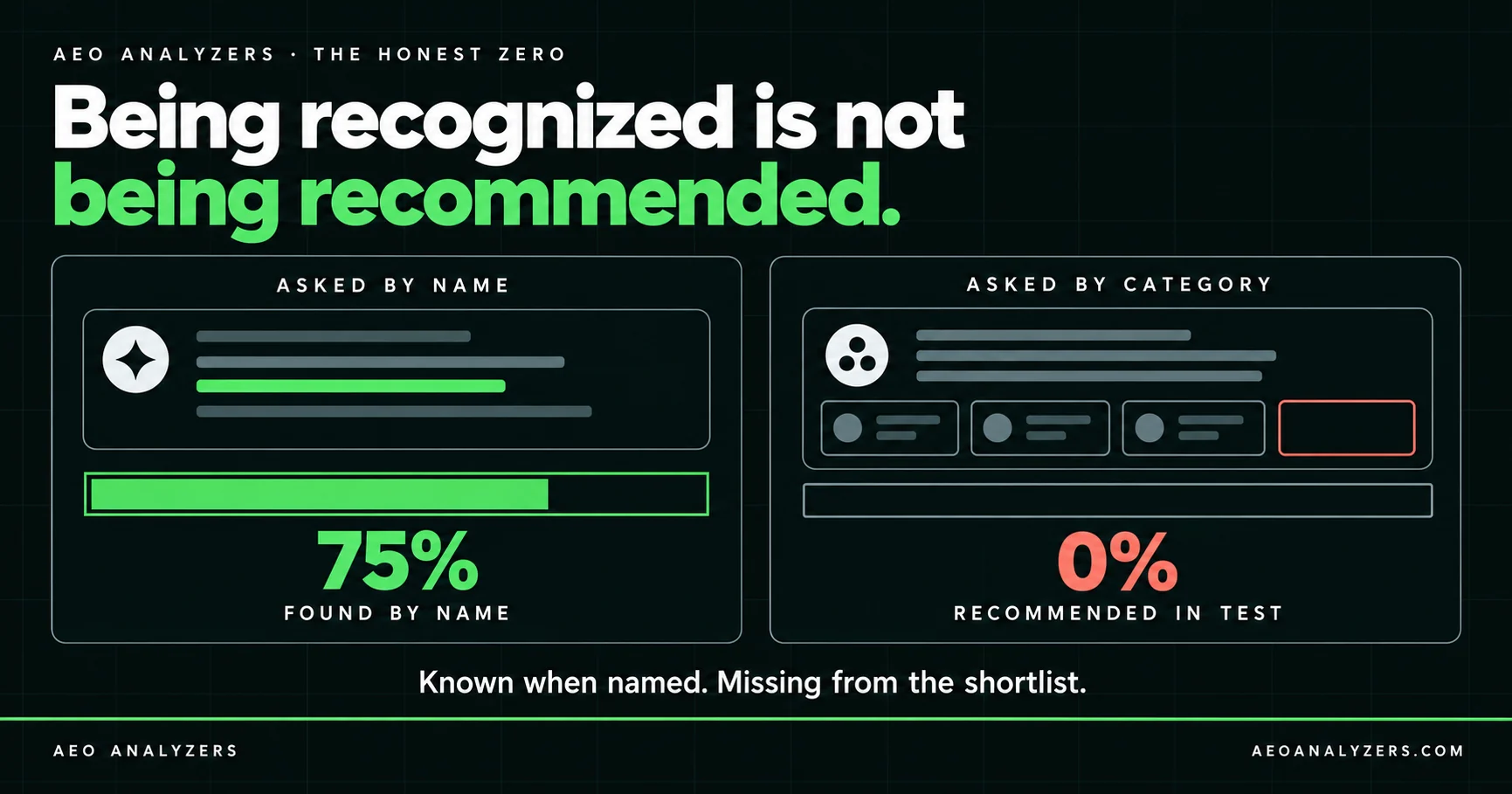
The result: zero percent.
When the engines were asked about AEO Analyzers by name, they found us in three of every four measured answers and, when they found us, described us accurately every time. When the engines were asked which companies to consider in our category, with no name in the question, we were not recommended once. That was 200 scored answers across four engines on October 13th, 2026, and the same again with a fifth engine added.
We published the result on our evidence page, with the transcripts behind it. Not because zero is an attractive number, but because it exposes the distinction at the centre of this whole subject:
Being recognised is not the same as being recommended.
If someone already knows your company, an AI assistant can probably describe it. If someone asks what to buy, who to trust, or which providers to shortlist, and never mentions your name, you may not appear at all. That is a different question, and it needs a different measurement.
A buyer can decide before they ever visit your website
Picture a purchasing manager looking for a scheduling platform. Instead of opening ten websites, they ask an AI assistant which tools handle multiple time zones well for a distributed team. They get a plausible, neatly written answer that names a few companies.
Your marketing team never sees that conversation. Your analytics record no click. The buyer has already started a shortlist.
So the question that matters is not whether an AI engine has heard of you. It is what that engine tells a buyer who has not.
The same websites, the same day, a 14-point difference
When we measured the same sites on the same day through two different panels of AI engines, the reported results differed by 14 points.
Nothing about the underlying businesses changed. The engines being asked were different.
That does not make measurement useless. It means a visibility score has to travel with its context: which engines were asked, which buyer questions, how many answers were scored, and when the test ran. A score without that information can look wonderfully precise while telling you less than you think.
Before asking whether your score rose, ask what was measured, and whether the next measurement used the same conditions.
Every result AEO Analyzers produces states the engine panel on its face and adds one line a buyer can understand: a different panel would produce a different number, and by roughly how much.
A one-point move is not automatically progress
There is a second problem that dashboards make easy to miss. The same question does not always get the same answer.
When we re-ran the same test on seven companies, the net average moved by 0.9 points, but single companies moved by as much as 17 points inside that average. Our own found-by-name figure went from 88% on October 8th to 75% on October 13th on the same four engines. Those are results from our tests, under our conditions, not a universal threshold for every system. They are enough to teach a useful habit: do not celebrate or panic over a small movement without first asking whether it exceeds ordinary variation under a comparable test.
Good measurement should prevent unnecessary work. It should not manufacture work every time a line moves.
Read the answer, not just the score
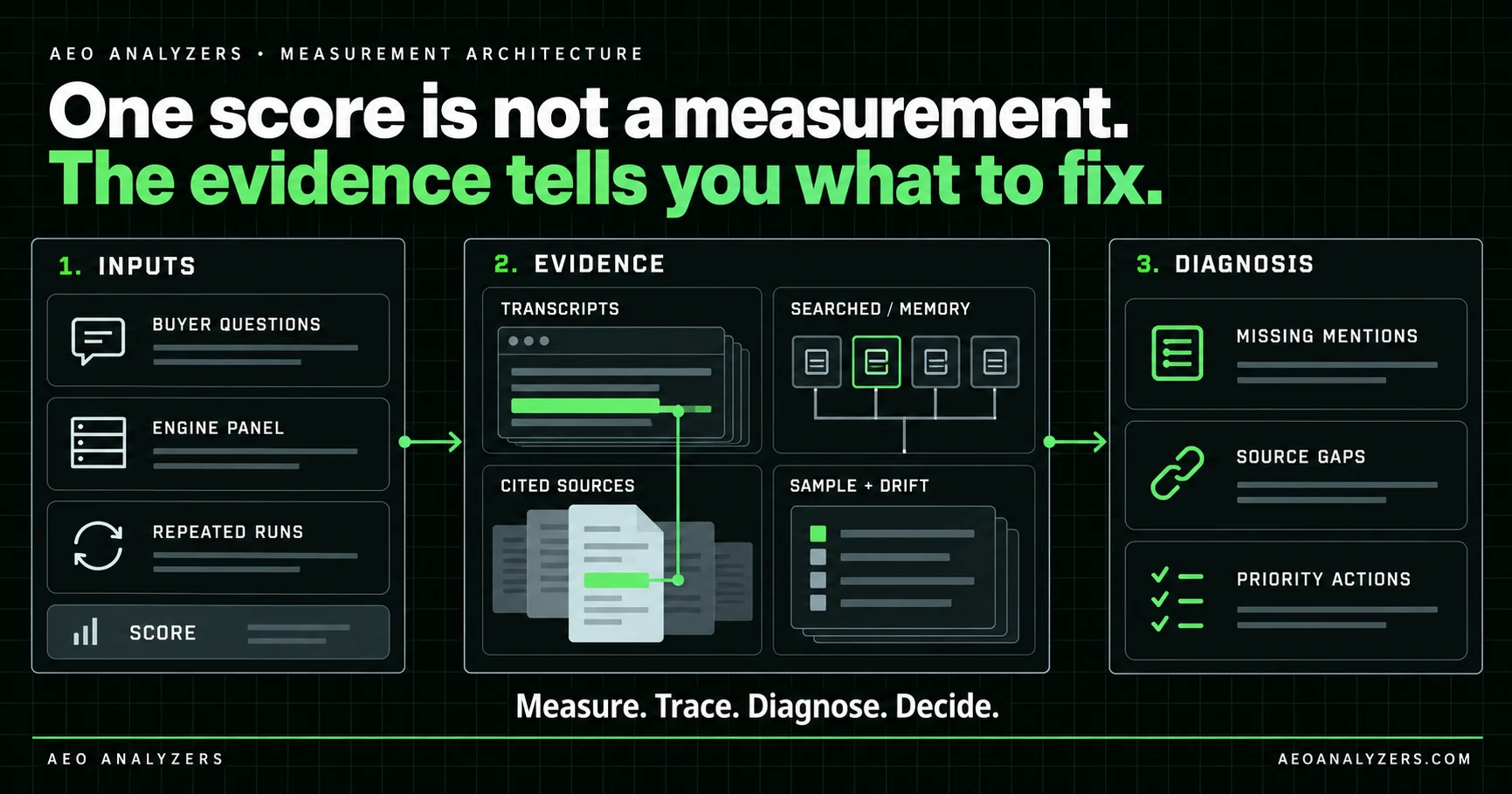
Here is what a single number cannot tell you. Did the engine mention your company in a passing list, or recommend it? Did it describe what you do accurately? Did it recommend someone else for the specific buyer need? Did it search the live web to form the answer, or respond from what it already knew? Which pages did it cite?
Those are not small details. They are the actual encounter between a buyer and an answer engine.
AEO Analyzers keeps the answers behind every reported number. Not to make the number more impressive, but so that a founder, a marketer, or a sceptical colleague can open the transcript and judge the result for themselves.
A searched answer and an answer from memory are also different observations, so we report them separately. A company can be easy to describe from memory and hard to surface through a live search, or the reverse. The right response depends on which one you are looking at.
EXHIBIT — one measured answer, from our own October 13th sweep
Buyer question (category, no company named): how to monitor if my brand appears in ChatGPT and Claude responses
Engine and mode: Perplexity · searched · 13 October 2026
What the engine answered (excerpt): "Use Apify AI Brand Monitor (apify.com) to run repeatable prompts across ChatGPT and Claude, tracking mentions, citations, sentiment, competitors, and share of voice.[1] For an enterprise dashboard, consider Meltwater GenAI Lens (meltwater.com); for DIY monitoring, run a fixed prompt set weekly in fresh sessions and log responses, cited domains, and accuracy.[2][3]"
Companies it recommended: Apify AI Brand Monitor, Meltwater GenAI Lens
Was AEO Analyzers recommended? No.
Sources the engine cited: https://www.shadow.inc/resources/how-to-monitor-brand-mentions-in-ai · https://apify.com/khadinakbar/ai-search-brand-monitor · https://nightwatch.io/blog/llm-tracking-tools/ · https://seranking.com/chatgpt-visibility-tracker.html · https://www.omniforce.run/blog/how-to-track-your-brand-in-chatgpt-ai-visibility · https://brandmentions.com/blog/chatgpt-brand-visibility-audit/ · https://www.meltwater.com/en/products/genai-lens · https://answersocrates.com/llm-brand-tracker · https://www.meltwater.com/en/blog/ai-brand-monitoring · https://www.airops.com/blog/ai-search-brand-monitoring-tools
Evidence: Full transcript →
The important detail is not that we were absent. It is that the engine produced a confident, reasonable answer without us. The score tells you the outcome. The transcript shows you what the buyer actually read.
Try this before your next marketing meeting
Ask an AI assistant to recommend businesses in your category. Do not mention your company. Note which businesses it suggests and how it explains the choices.
Then ask the same assistant about your company directly.
If it knew you when named and left you out when asked to recommend, you have just seen the difference between brand recognition and category discovery.
One conversation is not a benchmark. Answers vary, panels vary, and wording matters. But the experiment makes the business problem visible in under a minute, and it gives you a reason to measure it properly.
Three questions worth answering with evidence
- When the engines are asked about us by name, do they find us, and do they describe us correctly?
- When buyers ask the category question without naming anyone, do the engines recommend us, and if not, whom?
- Which answers and which sources produced those results?
Start there. Before optimising for a number, find out which buyer conversations you are missing and what the engines actually said.
Measure first. Then decide what to change.
AEO Analyzers is built for measurement and management. It reports what the tested engines said, discloses the panel and the answer count behind every figure, tags each buyer question by intent so you can see whether you were measured on questions close to a purchase, and keeps the evidence open for inspection. It does not edit your website, publish your content, or sell a remediation retainer.
That boundary is deliberate. The person who measures the problem does not need to be the person you hire to fix it. Your own team, your agency, or the consultant you already trust can read the transcripts and decide what action, if any, is justified.
We began by publishing a result about ourselves that we would have preferred to be different. That is the kind of evidence a measurement product should be willing to show.
What is AI telling buyers about your company?
Start with your company's URL at https://aeoanalyzers.com. The free check reads your site and shows you what a measurement would cover. A sweep answers the three questions above, states the engine panel and the answer count on the face of the result, and keeps every transcript so you can read what the buyer read.
You do not need to change anything on your website to begin. Measure first. Decide what to change afterwards.
The engines may already be describing your company. The question is whether you have read what they said.
If you work in marketing or SEO, I would value one thing in the comments: when someone reports your company's AI visibility score, what evidence do they show you?
Lindsay Hiebert is Founder and CEO of PIGENAI LLC and builds AEO Analyzers, an independent measurement tool for AI answer engines. The methodology and evidence pages are public at https://aeoanalyzers.com/methodology and https://aeoanalyzers.com/evidence.
AEO Analyzers (aeoanalyzers.com) was created and is solely maintained by Lindsay Hiebert, founder of PIGENAI LLC. It is unaffiliated with any similarly named browser extension, plugin, or tool.