We added a fifth AI engine. Here is what changed, and what did not.
Pro and Business Citation Sweeps now ask Grok, alongside ChatGPT, Claude, Perplexity and Gemini. The Day Pass stays on four engines. This is what the change means for the numbers you read, and what else we changed the same week.
Why add an engine at all
Your buyers do not all use the same assistant. Each one searches the web its own way, reads different pages, and names different companies. A measurement that asks one engine tells you about that engine. A measurement that asks several tells you about the answers your buyers are likely to see.
Grok is the fifth because it answers with live web search through an API, which is the only way we can ask it the same question under the same conditions every time.
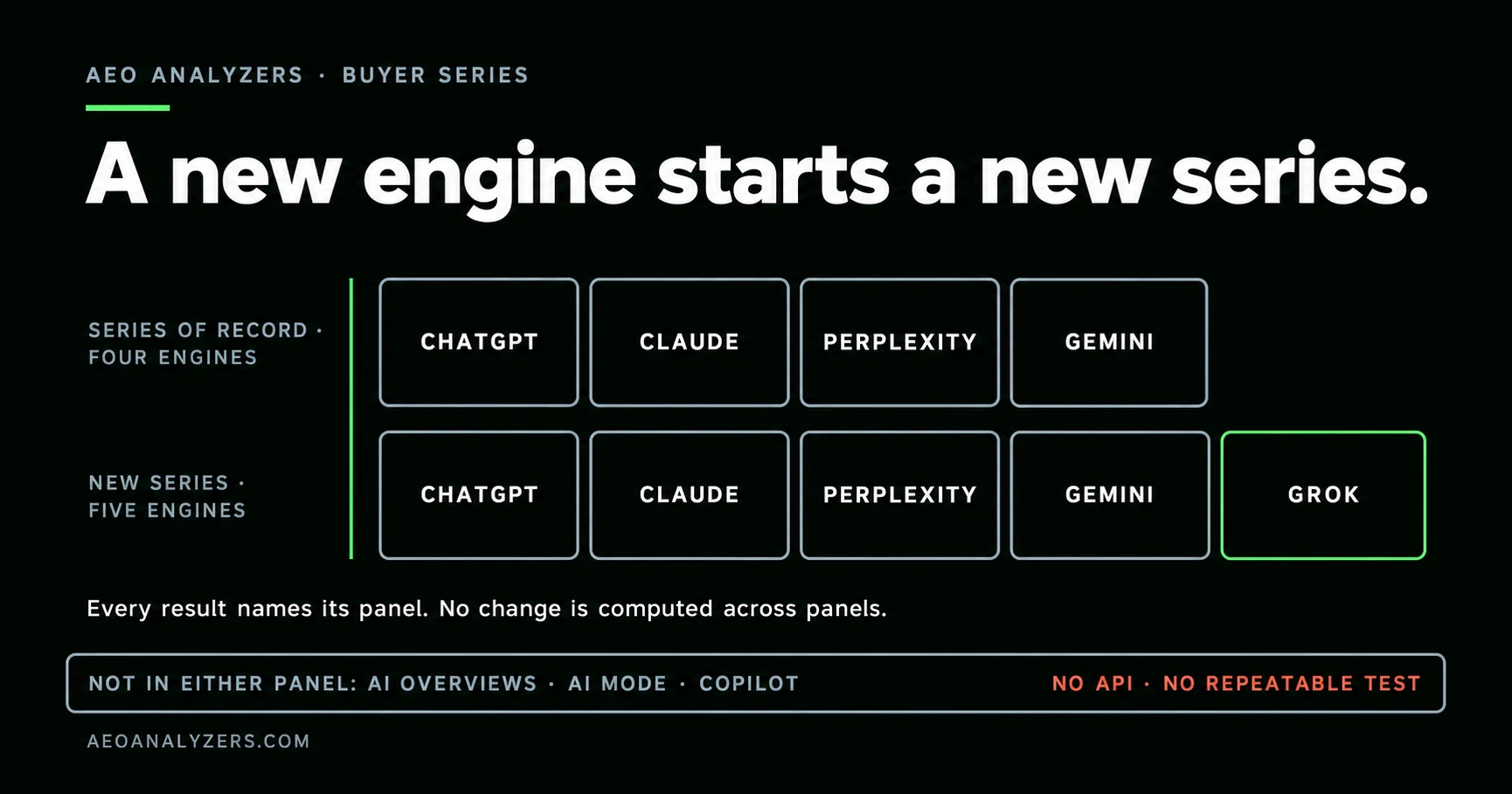
A new engine starts a new series
This is the part most tools skip. When you change which engines you ask, the number changes, even if nothing about your website did.
We measured this on ourselves. In one run on one date, adding a fourth engine to the same answers moved the average category recommendation rate by 14.0 points. Repeating the same three-engine run that day moved the average by 0.9 points, while single companies moved by as much as 17. A different set of engines is a different instrument.
So the five-engine panel starts its own series, from its own first date. Our monthly series of record stays on four engines, so each month compares with the last. We never compute a change between sweeps that used different panels, and every result names the panel that produced it.
Here is what that looks like on our own site, from the same answers on 13 October 2026:
- Four engines (ChatGPT, Claude, Perplexity, Gemini): found by name in 75% of 40 answers; recommended in 0% of 200 category answers.
- Five engines (the same four plus Grok): found by name in 80% of 50 answers; recommended in 0% of 249 category answers.
Both are true. They are not the same measurement, and we will not put them on one line.
Which engines are not in the panel, and why
Google's AI Overviews, Google's AI Mode and Microsoft Copilot are not in either panel. The reason is plain: none of them has an API that returns its answer. The answer exists only on a results page, and what that page shows depends on who is signed in, where they are, and what they searched before. Without an API we cannot ask the same question under the same conditions every time, so a figure for them could not be repeated or checked, and we do not publish figures that cannot be. We do not scrape those pages or imitate them.
What else changed the same week
We ran the new panel the way a customer would, on a paid account, and it found things.
An engine described us with last week's prices. Two days after our pricing changed, an engine asked about us by name answered with the old prices. Our report said every answer that named us was accurate, because the accuracy check covered only the company name and the founder. It now also checks the prices, plan names and free allowance your own site publishes, and when an engine states something different, the report shows the engine's claim and your site's value side by side.
Pages pulled up are not the same as confusion. When an engine searches your name, it sometimes pulls up pages about unrelated companies with similar names. If its answer about you was still right, those pages are now listed under "Retrieved alongside you," not reported as the engine confusing you with someone else.
A failed answer gets one more try. Engines rate-limit and time out. An answer that fails is now asked again once before it is left out, and the report says when an answer was left out after a retry.
What this does not do
A fifth engine does not make anyone recommend you. It makes the measurement wider. What you do with it is the same as before: measure what the engines say, manage what you can change on your own site and in the sources they read, and measure again on the same panel to see whether it moved.
Every number in a sweep comes from a stored answer you can read. That has not changed.
Run a Citation Sweep · How we measure · Our own numbers
Related
AEO Analyzers (aeoanalyzers.com) was created and is solely maintained by Lindsay Hiebert, founder of PIGENAI LLC. It is unaffiliated with any similarly named browser extension, plugin, or tool.