The AEO Buyer’s Guide: three short reads
Six minutes total. What an AEO tool should do, what to require before you buy, and how to compare the market — each with a link to the full guide.
We make one of the tools in this category and say so throughout. These three are the fast version; each links to a longer piece that shows its working.
AEO Analyzers is an answer engine optimization tool that reports whether ChatGPT, Claude, Perplexity and Gemini find a business by name, describe it accurately, and recommend it to buyers who did not ask for it by name.
What should an AEO tool actually do?
If you are shopping for AEO software, start with the failure — not the feature list.
“AI visibility” can describe several very different outcomes. An answer engine might know your company exists, mention it, link to it, cite it as a source, describe it accurately, or recommend it when a buyer asks an unbranded question. Those are not interchangeable wins.
That is why the first purchasing question should not be “how many dashboards does this platform have?” It should be: what part of the problem can this tool help us solve?
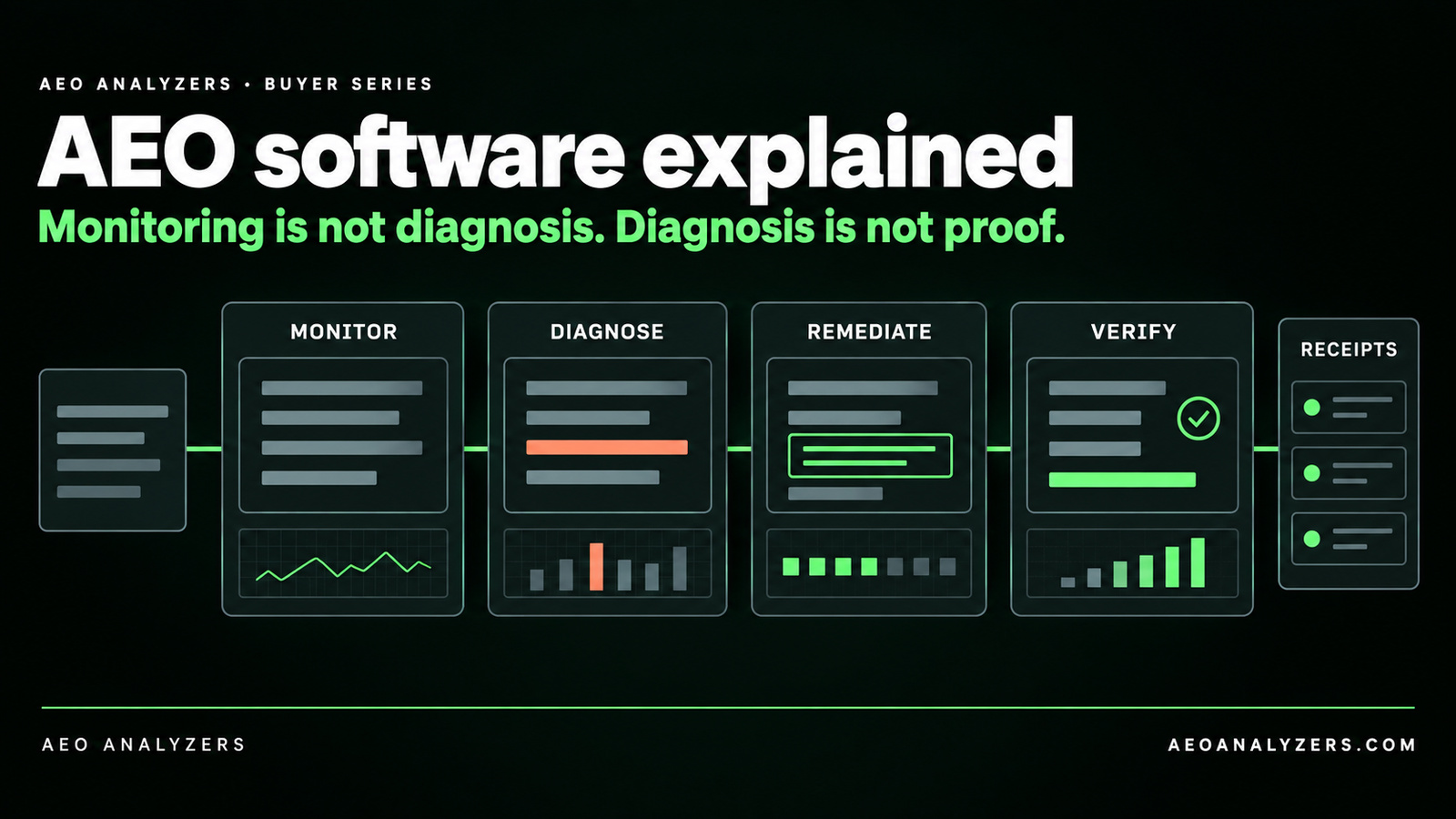
A simple way to evaluate the category is to look for five capabilities. Can the tool observe what the engines are actually doing? Can it diagnose why you are missing, misrepresented or losing to a competitor? Can it turn that diagnosis into a concrete change? Can it verify whether the answer moved afterwards? And can it do all of that at the scale your organisation actually needs?
That distinction matters because monitoring, diagnosis, remediation and verification are different jobs. A platform can be excellent at one without being designed around the others.
The best AEO tool is therefore not automatically the one with the longest feature list. It is the one that solves the part of the AI-answer problem you actually have — and produces enough evidence for you to make the next decision with confidence.
Companion long read. The AEO decision loop in depth — Observe, Diagnose, Fix, Prove, Scale — and the differences between mentions, citations, factual accuracy and unbranded selection. Read the full guide →
What should you require before you buy?
The AEO market does not need another feature checklist. Buyers need purchasing requirements.
Before comparing vendors, establish the standard you expect every platform — including ours — to meet. Seven questions will tell you more than a page of feature badges.
Observe. What exactly is the product measuring — mentions, links, citations, recommendations, factual accuracy, or something else?
Diagnose. Can it explain why the result happened, or does it only report that the score moved?
Remediate. Does it produce data, general recommendations, or implementation-ready changes your team can actually use?
Verify. Can you retest the real question after a change and see whether the outcome improved?
Show the receipts. Can you inspect the prompts, engines, dates, answer text and evidence behind the metric?
Scale. Does its operating model fit one site, an agency portfolio, or a global enterprise?
Economics. Are you buying prompts, checks, engines, credits, projects, seats — or some combination?
AEO metrics should have receipts. If a platform tells you visibility is 42%, you should be able to ask: 42% of what? Which questions, which engines, which answers, which competitors? A metric that cannot be traced back to evidence is much harder to challenge, diagnose or act on.
That does not mean every buyer needs every capability. It means buyers should know which capability they are purchasing — and which one they are not.
Companion long read. All seven requirements, the thirteen questions to take into a vendor call, and how we score against the standard ourselves — including where we come off worst. Read the full standard →
How should you compare the tools on the market?
There may not be one “best” AEO platform, because buyers are purchasing different outcomes.
One company needs enterprise monitoring across brands, countries and thousands of prompts. Another wants AI-search analytics inside an existing SEO workflow. Another needs agent-experience infrastructure. Another simply needs to know why ChatGPT, Claude, Perplexity or Gemini is failing to retrieve, describe, cite or choose its site — and what to change next.
Those are different buying problems, so a fair comparison should not force every product into the same mould.
Do not choose AEO software by counting features. Choose it by the decisions it can help you make.
A practical comparison starts with the same requirements for every vendor: what can it observe, what can it diagnose, what can it help you remediate, can it verify the outcome, can you inspect the evidence, can it operate at your scale — and what will your real workload cost?
We make AEO Analyzers, so our comparison should be read with that disclosure. The standard, however, should work against us too. If another platform is a better fit for a buyer’s requirements, the comparison should say so.
That is the point of a buyer’s guide: not to manufacture a winner, but to make the purchasing decision easier to defend.
Companion long read. A vendor-by-vendor comparison of AEO Analyzers, Profound, Peec AI, Otterly AI, Scrunch AI, AthenaHQ, Rankscale and SE Ranking against the same purchasing requirements. Read the full comparison →
Vendor facts in the companion comparison were read from each vendor’s own published pages. As of date checked: 2026-09-21.