What Should an AEO Tool Actually Do?
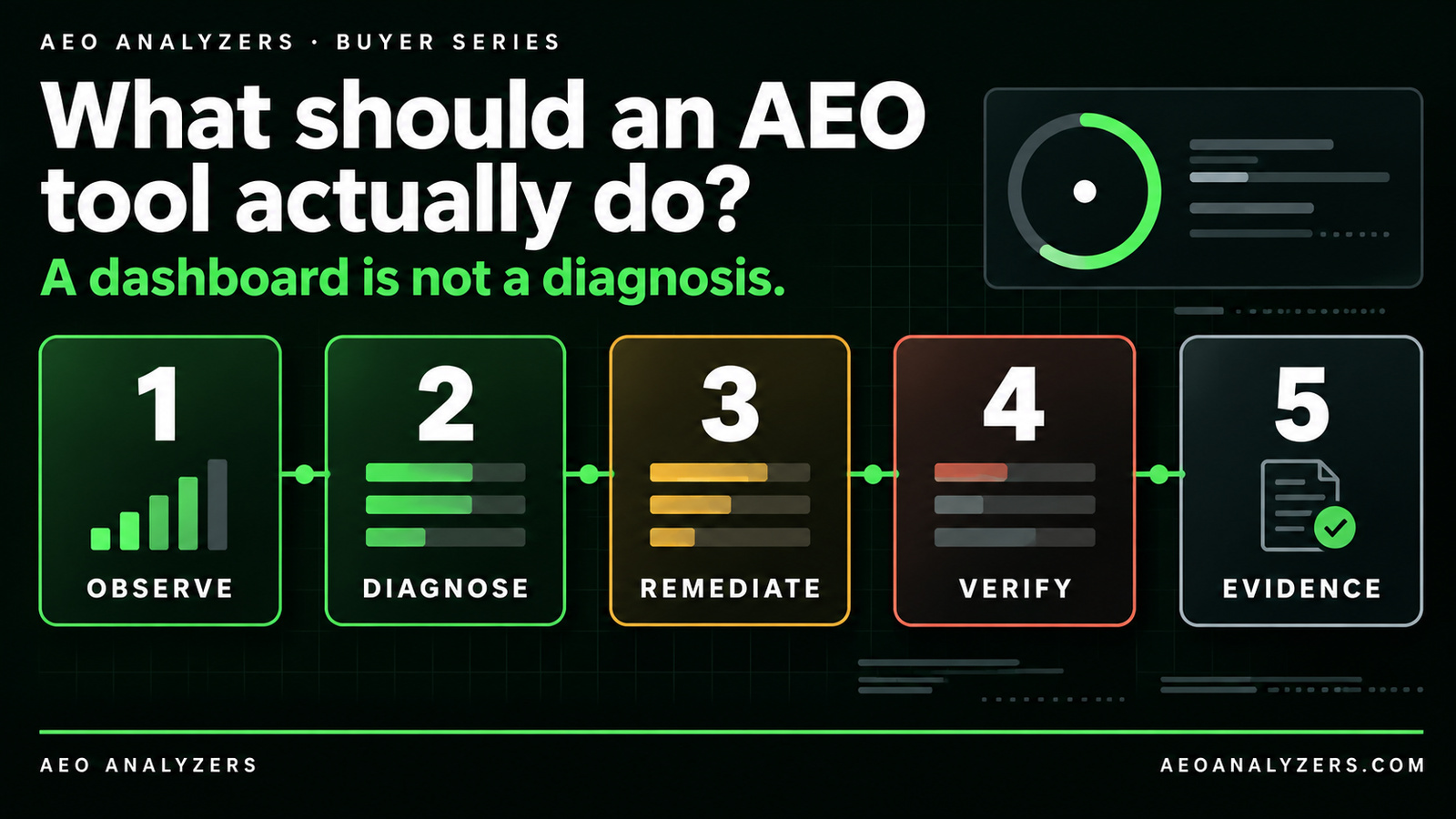
AI visibility is only the beginning. A useful AEO platform should help you observe the problem, diagnose the cause, make a change, and verify that the answer moved.
We make one of the tools in this category, so treat this as interested testimony and check it. This piece names no vendor and compares nothing — it defines the terms. The comparison lives in a separate article, written against the standard in the second.
“What is our AI visibility score?” is the wrong first question. Not because visibility does not matter, but because the phrase covers at least six different outcomes, and the fixes for them have almost nothing in common.
What does “AI visibility” actually mean?
- The engine knows your company exists.
- The engine mentions your company.
- The engine links to your site.
- The engine cites your page as a source.
- The engine describes your company accurately.
- The engine recommends you for an unbranded buying question.
A single number that blends those can hide a business that is perfectly findable by name and never recommended to a buyer. That is not a weaker version of the same problem. It is a different problem with a different cause and a different fix.
Mention, citation, recommendation — what is the difference?
Most confusion in this category collapses into seven inequalities:
- A mention is not a citation. Being named in prose and being used as a source are different events, and only one sends a reader to you.
- A citation is not a recommendation. An engine can cite your page while recommending somebody else.
- Retrievability is not fidelity. Being found is not being described correctly.
- Fidelity is not competitive selection. An accurate description does not win an unbranded question.
- Measurement is not diagnosis. Knowing the number fell does not tell you why.
- Diagnosis is not remediation. Knowing why does not produce the change.
- Remediation is not proof. Making the change does not mean the answer moved.
Where does an AEO tool sit in the workflow?
OBSERVE → DIAGNOSE → FIX → PROVE → SCALE
Every platform in this category sits somewhere on that loop, and most are strongest at one or two stages rather than all five. That is not a criticism of any of them; it is what a category looks like before it consolidates. It does mean a buyer has to know which stage is broken for them before a feature list can mean anything.
Four kinds of software, four different questions.
- Monitoring asks: what is happening?
- Diagnostic asks: why is it happening?
- Remediation asks: what should we change?
- Verification asks: did the change alter the outcome?
Before buying AEO software, work out which of those four answers you are actually paying for. Most products in this category do more than one. Almost none do all four equally well, and the price rarely tells you which.
What are the four jobs hidden inside “AI visibility”?
AEO software is still described with overlapping labels: AEO, GEO, AI visibility, LLM optimization, AI search analytics. The labels matter less than the operating job. A buyer usually needs one or more of four things: know what the engines are saying, understand why the result happened, change something that could improve it, and verify whether the change affected the answer. Those are different jobs.
1. Monitoring answers “what happened?”
Monitoring is the foundation. It can reveal whether a brand is mentioned, linked, cited or absent; how often competitors appear; which sources are influential; how results change over time; and how performance varies by engine or market. At scale, this is extremely valuable. But monitoring alone does not necessarily explain causality. A decline in share of voice can be the symptom of a content gap, a retrieval issue, a stronger competitor source, an entity problem or simple answer variability.
2. Diagnosis answers “why might it be happening?”
Diagnosis turns a metric into a working explanation. It can include crawlability and robots checks, content structure, entity consistency, schema, source analysis, citation patterns, competitive gaps, inaccurate claims or recurring objections. The purchasing question is whether the platform only tells you where you lost or also gives you a defensible explanation of the likely failure mode.
3. Remediation answers “what should we change?”
Not all recommendations are equal. A recommendation can be a dashboard insight, a generic best practice, a prioritized content brief, a concrete rewrite, a schema block, a technical fix or an agent-assisted workflow that changes a page. Buyers should ask how far the software takes them from insight to implementation. The answer determines how much additional expertise, agency support or internal labor is still required.
4. Verification answers “did it work?”
AEO is probabilistic. A page can be improved and still produce different answers across runs or engines. Verification therefore matters. The strongest loop is to rerun the same decision-relevant questions after the intervention and compare the actual answers, citations and factual claims. A recommendation is a hypothesis until the answer behavior changes.
5. Evidence answers “can I inspect the result?”
AEO metrics should have receipts. If a dashboard reports 37% visibility, a serious buyer should be able to understand what that number represents: which prompts, which engines, which dates, how many runs, and whether the brand was mentioned, linked, cited or recommended. Where technically practical, the metric should trace back to the underlying answer and citation evidence.
AEO metrics should have receipts.
What this means for buyers
AEO software should not be evaluated as a single undifferentiated category. A global brand may primarily need high-volume monitoring, regions, executive reporting and integrations. A smaller company may need a fast diagnostic that identifies what is wrong with one site and produces fixes. An SEO team may prefer AI search inside its existing SEO operating system. An infrastructure team may care about what AI agents receive when they visit the site. The right product depends on the job.
Why is one run not a measurement?
Generative answers are probabilistic. Ask the same engine the same question three times and the named companies and cited sources can differ. Any figure produced from a single run is an anecdote, and a percentage published without its question set, its repetition count and its date is not a measurement anyone can reproduce or dispute.
This is also why a search-grounded answer and one recalled from the model’s training are different measurements. Blending them moves a score invisibly in either direction.
AEO Analyzers measures three of these outcomes separately — retrievability, fidelity and citation win — rather than combining them into a single visibility score.
What do we do with this ourselves?
We report three of those outcomes separately rather than blending them: whether an engine finds you when asked by name, whether what it says is accurate, and whether it recommends you to someone who did not ask for you. We publish our own numbers monthly, including the ones that are zero. On the unbranded category questions in our September 2026 measurement, engines recommended us in 0 of 200 recorded answers.
We are telling you that because a company selling measurement honesty should be legible on its own numbers first.
This is part of a three-part series on buying AEO software.
- New to the category? What should an AEO tool actually do?
- Evaluating vendors? The AEO Buyer’s Standard — 13 questions to ask before you buy
- Ready to compare products? Best AEO tools & software in 2026
- Short on time? All three in six minutes
Vendor facts here were read from each vendor’s own published pages. As of date checked: 2026-09-21. If something is out of date, tell us.