AEO Analyzers Start free →
← Back to the blog
AEO Analyzers · The answer-engine shift

Is your brand the answer AI gives — or is a competitor?
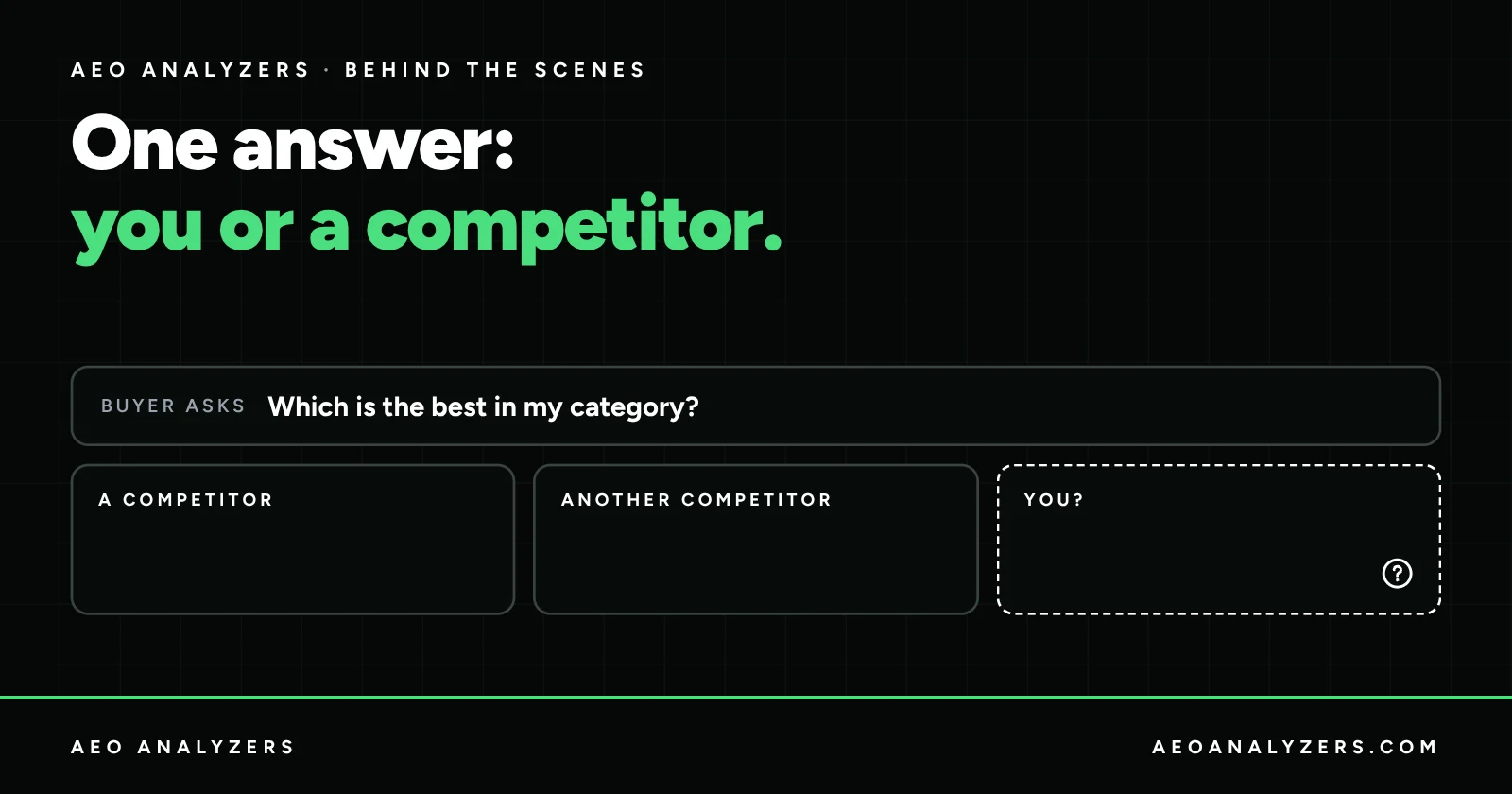
One answer: you or a competitor. A buyer asks which is the best in their category, and the answer lists a competitor, another competitor and a dashed box asking whether it is you.

Updated 15 October 2026: Pro and Business sweeps now ask five engines, adding Grok. The method is otherwise unchanged.
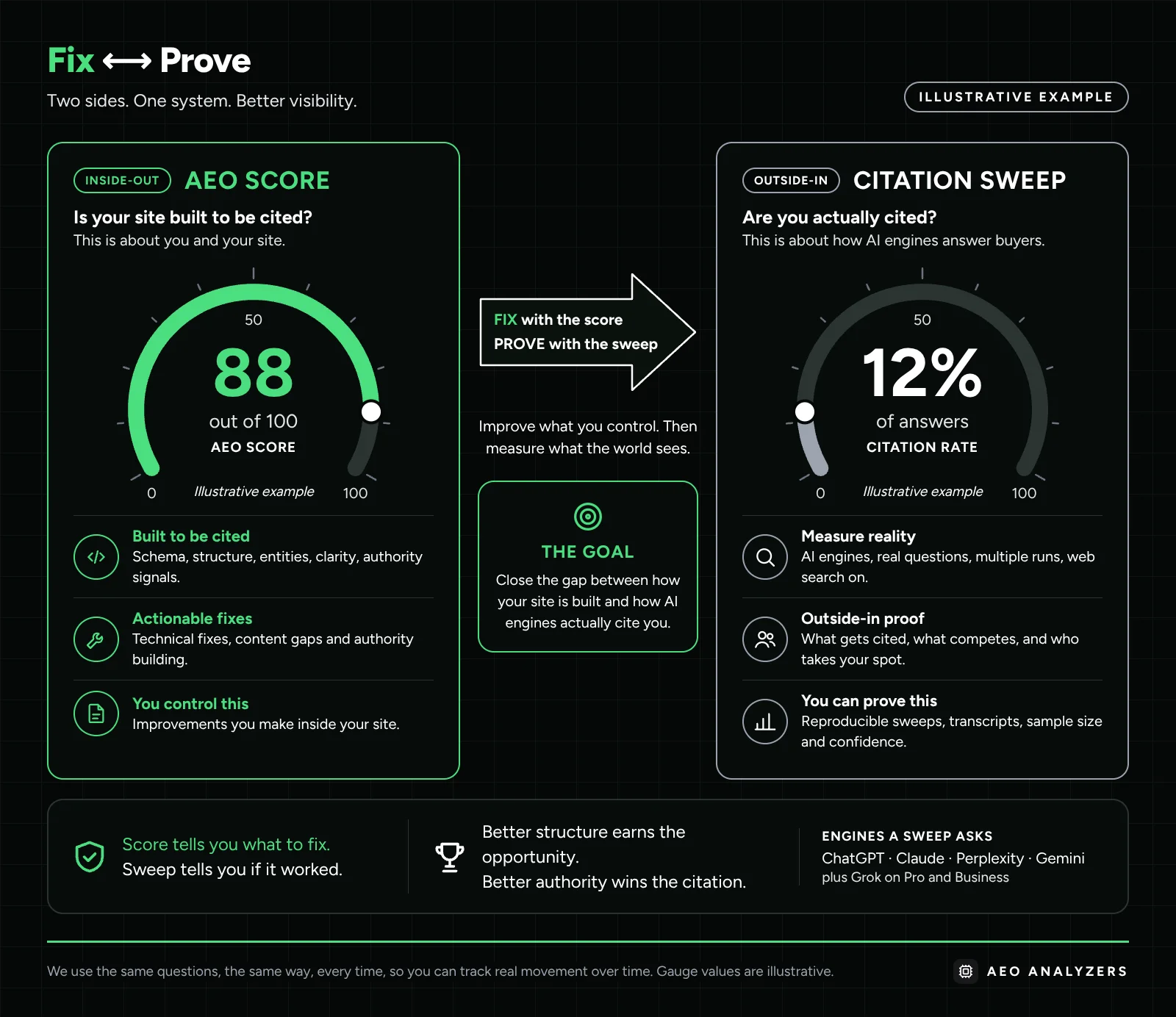
Illustrative example titled "Fix ⟷ Prove: two sides, one system, better visibility." Left, inside-out, AEO Score: is your site built to be cited? This is about you and your site. A gauge labeled AEO Score reads 88 out of 100 (illustrative example). Built to be cited: schema, structure, entities, clarity, authority signals. Actionable fixes: technical fixes, content gaps and authority building. You control this: improvements you make inside your site. Middle, an arrow: fix with the score, prove with the sweep. Improve what you control, then measure what the world sees. The goal: close the gap between how your site is built and how AI engines actually cite you. Right, outside-in, Citation Sweep: are you actually cited? This is about how AI engines answer buyers. A gauge labeled citation rate reads 12% of answers (illustrative example). Measure reality: AI engines, real questions, multiple runs, web search on. Outside-in proof: what gets cited, what competes, and who takes your spot. You can prove this: reproducible sweeps, transcripts, sample size and confidence. Bottom: score tells you what to fix, sweep tells you if it worked. Better structure earns the opportunity; better authority wins the citation. Engines a sweep asks: ChatGPT, Claude, Perplexity, Gemini, plus Grok on Pro and Business. We use the same questions, the same way, every time, so you can track real movement over time. Gauge values are illustrative.
Illustrative example. The AEO Score shows what to fix on your own site; the Citation Sweep shows whether answer engines actually cite you. Gauge values are illustrative, not a real result.

Your next customer probably won’t Google you. They’ll ask ChatGPT, Gemini, or Perplexity “what’s the best option for me?” — and act on whatever it names.

There’s no page two anymore. There’s one answer. So the question that decides your pipeline isn’t “where do I rank?” It’s “am I the answer?” The one most or all of the AI engines give? Only one of them? Or none at all?

Most brands have never checked. The ones who do are usually surprised. They’re found by name — but on the questions that actually sell, a competitor wins. Your story ends up told secondhand, and often a year out of date.

And the few who do check are mostly guessing. They type one question into one favorite engine, once. Ask it a little differently and the answer changes. Queries swing from vague to cherry-picked — or never get asked at all. Almost no one runs the same buyer questions, the same way, across every major engine, and compares fairly on the answers their business wants to be known for.

That’s what a Citation Sweep report measures. It doesn’t guess, and it doesn’t estimate from a crawl. It runs your real buyer questions across five live answer engines on Pro and Business, four on the Day Pass — repeatedly, and measured the same way every time, with the receipts. That’s the difference between guessing and knowing.
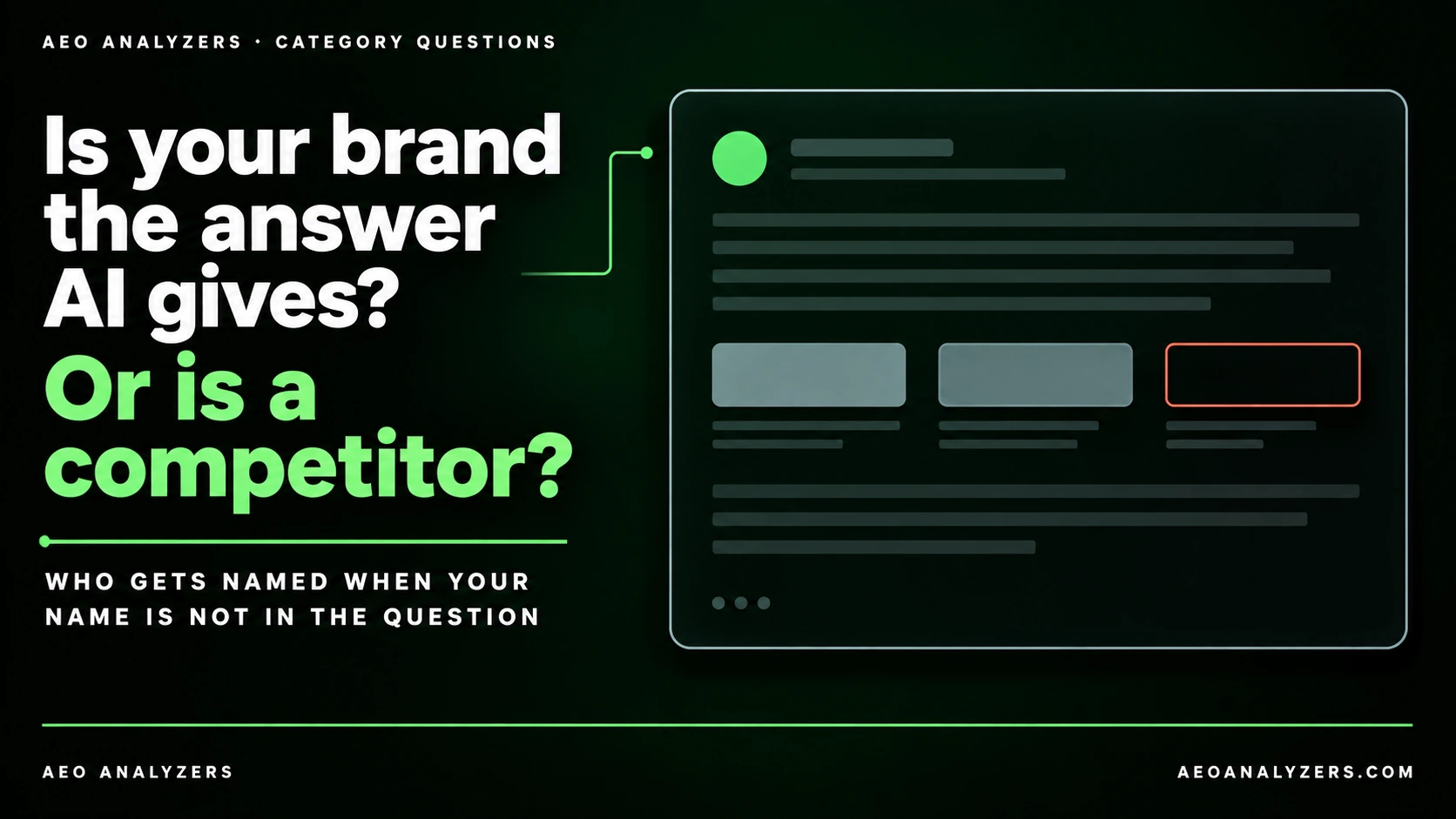
Title card: Is your brand the answer AI gives? Or is a competitor? Who gets named when your name is not in the question. Beside it, an AI assistant's answer panel drawn as dim placeholder lines, with three source chips inline: two filled grey and unlabelled, one outlined in red and empty.
The buyer asked the category question. The answer named somebody. The empty outline is the seat that was not yours. The figures in this post describe a worked sample, so the card carries none of them.

Here’s a full sample report. “Meridian Payroll” is fictional and the figures are illustrative — but the format, and the six things this report does, are exactly what you would get for your own site.

SAMPLE REPORT · illustrative example — figures are representative, not measured. Your report is generated from your live data.
How you get one: the free AEO analysis reports your diagnosis — your score, your gaps, and what is blocking you. Pro and Business plans include Citation Sweeps every month across five answer engines, adding Grok; a Day Pass unlocks a full sweep across four. Each sweep stores every answer’s transcript and comes with a downloadable Word report. The executive report shown here is the same measurement, written up for a boardroom; ask us for one and we will tell you honestly whether your sweep needs it.
AEO Analyzers · Citation Sweep report

Meridian Payroll in the age of AI answers

60 live queries · ChatGPT · Gemini · Perplexity · Claude · every answer’s transcript recorded

Buyers no longer start on Google — they ask an AI assistant “what’s the best payroll software for a small business?” and act on whatever it names. There is no page two. Either Meridian is in the answer, or a competitor is. Here is where you stand today, and every number below is yours to reproduce.

Branded retrievability
100%
Ask about Meridian by name and all four engines find you. Not the problem.
Category citation win
34%
On the questions that sell — without your name — you’re named only 1 in 3 answers.
Cited instead of you
14×
“PayNorth” took the answer 14 times; “LedgerLine” 11. Every miss is a lead handed over.

What we found

Are you the answer the AI gives? By name — yes. On the questions that actually sell — no.

  • Every engine knows Meridian by name — branded retrievability is 100%. Your brand is discoverable.
  • On “best payroll software for small business,” Meridian was cited 1 of 12 times. Perplexity named you zero of three.
  • The engines lean on PayNorth, LedgerLine, a 2023 review round-up, and YouTube. meridianpayroll.com never appeared among the trusted sources. Your story is being told secondhand — often a year out of date.
  • One thing this doesn’t show: which AI crawlers actually read your site. Being read and being cited are different measurements, and closing the gap starts with the citation numbers above.

We see the same split on our own site: found by name, and recommended in none of 200 category answers in our 13 October test. How we read that result, transcript first.

Why this report is different

Here are six things this report does — and each one decides whether you actually win the answer.

We actually measure it — not estimate it.

60 real questions asked to four live AI answer engines, three times each, with the full transcript of every answer stored.

We name who’s cited instead of you.

Per-engine counts of the exact competitors and sources winning the answers you should own. Plus the authoritative sources behind them — how and why you’re seeing these results.

We hand you the real fix, not just the verdict.

Paste-ready JSON-LD schema and the specific page rewrites — a developer can ship them the same day.

We check whether AI can even read you.

A crawler-access audit of robots.txt and llms.txt. If a citation-critical bot is blocked, we cap the score and flag it in red — because nothing else matters until it’s fixed.

We catch when AI gets your facts wrong.

We diff every answer against your canonical facts. Then we flag misattribution, stale claims, and outright fabrication. Being cited wrong costs you the sale too.

Every number is reproducible — no black box.

The queries, the engines, and the transcripts are all in the report. You (or your agency) can re-run any single answer and see the same result. We’d rather be checkable than impressive.

Your first three moves

  1. Publish a current-year “best payroll software” answer page on meridianpayroll.com.Build a schema-marked, FAQ-structured page. Write it the way an AI quotes — short, direct answers to the exact questions buyers ask. Now the engines have a fresh, first-party source to cite. Not a 2023 round-up.
  2. Close the Perplexity gap (cited 0 of 3).Make sure your key pages are cleanly indexable by Bing. Bing feeds Perplexity and several other answer layers. Then get current on the third-party sources the engines already trust — so you show up where they’re already looking.
  3. Re-measure monthly, the same way every time.Re-run this sweep every month with the same questions, so a change in the number means a change in the world and not a change in the method. Make “share of AI answer” a tracked KPI. The brands that win in 2026 treat it like share of search a decade ago.

AEO Analyzers · Inputs are the checklist. Citation rate is the score.

The report above is a SAMPLE used for illustrative purposes only. “Meridian Payroll,” “PayNorth,” and “LedgerLine” are fictional and the figures are representative, not a measurement of any real company. A real report is generated entirely from your own live site and buyer questions, with every transcript included.

Updated October 2026: Pro and Business ask five answer engines, now including Grok. See We added a fifth AI engine.

Your move

Is your brand the answer AI gives — or is a competitor?

Here’s what you get — and keep getting, month after month: Citation Sweeps run to the same panel every month, so a change in the number means a change in the world and not a change in the method.

See exactly where you stand — today, or any day. Get the real fixes and an action plan built to move the numbers. Then re-sweep and see whether the numbers moved. We report what the engines did; we do not promise what they will do next.

Find out whether AI recommends you for what you do — and what it would take to change that.

Do your own comparison. Run the comparison yourself — every number we show you, you can reproduce.

Check your brand — free →